
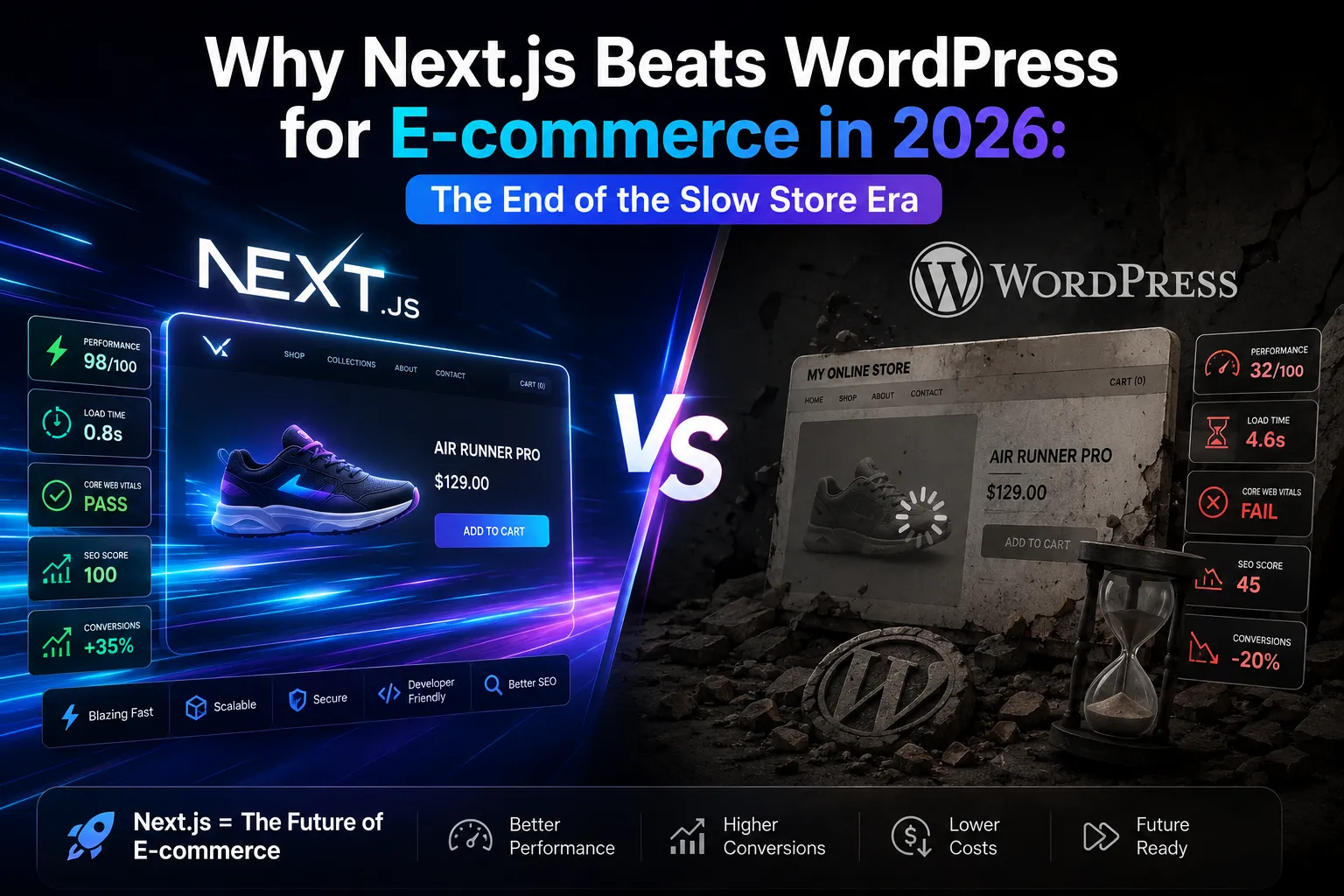
Why Next.js Beats WordPress for E-commerce in 2026: The End of the Slow Store Era
Imagine this scenario: you've invested thousands of dollars in ads, a customer clicks your banner, lands on your site... and waits. One second. Two. Three. On the fifth second, they close the tab and go to your competitors. Your marketing budget just burned up because of a slow website.
If your online store runs on WordPress (WooCommerce), this story sounds familiar.
Today, we're going to talk about why modern E-commerce is fleeing WordPress en masse and migrating to Next.js. This isn't just a technology change — it's a transition from a "homemade" store to an enterprise solution that runs at the speed of light.
Pain #1: The Plugin Trap and "Turtle" Speed
WordPress was created over 20 years ago as a blogging platform. To turn it into a store, you need the WooCommerce plugin. To add filters, another plugin. Caching? A third. SEO? A fourth. Payments, shipping, multilingual support...
As a result, your site drags along tens of megabytes of unnecessary code (CSS/JS) from every single plugin. The server "sweats" trying to piece the page together on every single user request.
How Next.js solves this: Next.js uses a pre-generation approach (SSG/ISR). Instead of assembling the page at the moment of the click, Next.js generates product pages in advance and distributes them globally via a CDN (Content Delivery Network). When a customer (even with a poor mobile connection, for example, ordering crucial tactical gear from the field) visits the site, they receive a ready-made page in milliseconds. No "thinking" plugins involved.
Pain #2: Black Friday and "Server Crashes"
The ultimate nightmare for a WordPress store owner is a sudden spike in traffic. You launch a killer promo, and 1,000 people hit the site simultaneously. Every single one of them makes a database request. The database can't handle it, goes down, and instead of profit, you get "Error 502 Bad Gateway" and angry comments on social media.
How Next.js solves this: Thanks to its "Headless" architecture (where the frontend and backend are separated), your Next.js application isn't directly connected to the database at all. It communicates with the backend via an API. Even if 100,000 people visit the site, they will simply download lightweight static files that don't "crash" the server. Your VPS, configured with Docker and Nginx, will survive any Black Friday.
Pain #3: Google's "Green Zone" (SEO)
Google has officially stated: site speed (Core Web Vitals) is a key ranking factor. WordPress stores often show red or yellow scores in PageSpeed Insights due to heavy code and slow server response times (TTFB). You can write perfect SEO copy, but Google will still rank your faster competitor higher.
How Next.js solves this: Next.js is built for perfect SEO. Thanks to Server-Side Rendering (SSR), Google's search bots instantly receive fully rendered HTML code with all the meta tags. Switching to Next.js often yields 90-100 points in PageSpeed right "out of the box," which automatically boosts your store in free organic search results.
Pain #4: Design Prison (Templates)
In WordPress, you are always constrained by the limits of your chosen theme (template). Want to change the checkout logic or add a custom animation to the cart? Get ready for "crutches," plugin conflicts, and the reality that after the next theme update, your custom code will simply vanish.
How Next.js solves this: You have absolute freedom. Next.js is based on React — you or your developer build the interface from scratch, like Lego bricks, using strictly typed TypeScript. Any unique design, complex filters, or instant search — everything works as smoothly as a native smartphone app. No "themes" bogging down the site.
Pain #5: Leaky Security and Hacks
When it comes to serious e-commerce with real purchases, online payments, and customer databases, security is priority number one. WordPress is the most popular CMS in the world, which also makes it the #1 target for hackers. Most hacks occur through vulnerabilities in those very free plugins that owners install to expand functionality. One outdated plugin — and your customers' database ends up online, while malicious ads appear on your site.
How Next.js solves this: In a Headless architecture, your frontend (what the customer sees) has absolutely no direct access to the database or admin panel. There is no wp-admin page to brute-force (guess passwords). The Next.js server only serves secure, compiled code to the client. Your backend (where the money and data reside) is safely hidden behind APIs and firewalls. Hacking such a system is a highly complex task even for professional hackers.
Pain #6: The Myth of "Cheap WordPress" (Total Cost of Ownership)
People often say, "But WordPress is free, and Next.js development is expensive!" This is the biggest illusion in E-commerce.
Yes, you can launch a WP store in a week for almost nothing. But what happens next? The site starts lagging — you hire a developer to optimize the database. A plugin conflicts with the theme after an update — you pay for emergency repairs while sales are stalled. You need a custom integration with an ERP, CRM, or a new loyalty system — developers hand you astronomical bills for "crutches" built on top of legacy code.
How Next.js solves this: Development on Next.js is an investment. Yes, the initial check is higher because the system is built by engineers, not dragged and dropped with a mouse. But in the long run, you save thousands of dollars. You don't have to update plugins every week and pray nothing breaks. Integrations with any payment systems or CRMs are done easily, cleanly, and work stably for years. You pay once for a solid foundation, rather than "feeding" developers with constant minor repairs.
"Headless E-commerce" in Plain English
People often ask: "So where do I store my products if not in the WP admin panel?"
This is where Headless architecture steps in. Imagine a restaurant.
WordPress is when the chef (backend) and the waiter (frontend) are the same person, running back and forth and getting exhausted quickly.
Next.js (Headless) is an elite establishment. You have a top-tier kitchen (the backend — which could be Shopify, Medusa.js, or your custom Django/Node.js backend) that solely prepares the data. And Next.js is the fast, elegant waiter who instantly delivers this data to the customer.
You get the best of both worlds: a powerful admin panel for managers and a lightning-fast interface for buyers.
Summary: When is it time to switch?
Let's be honest: WordPress is a great tool for validating ideas, launching a business, or running a standard store where traffic is predictable and WooCommerce's core features are enough.
But if you:
Are spending serious budgets on traffic.
Are losing customers during long cart loading times.
Want to stand out with a unique design, not a cookie-cutter look.
Aim to crush your competitors in SEO.
...then your next level is Next.js. It is an investment in a foundation that will withstand any scaling of your business.
Коментарі (0)
Leave a comment